What does OSHA require for handwashing on a job site?
Two different rules cover this, and contractors mix them up constantly. General potable water access falls under OSHA 1926.51(a)(1), which just says an adequate supply has to be there. Toilet counts are separate, covered by OSHA 1926.51(c)(1): one facility for crews of 20 or fewer, then one toilet seat and one urinal per 40 workers as headcount climbs, dropping to one per 50 once you hit 200 workers on site. Neither of those is a blanket handwashing mandate. That's where 1926.51(f)(1) comes in specifically: it applies when workers are applying paints, coatings, herbicides or insecticides, or handling other contaminants that could land on skin. If your crew is running a sprayer or spreading pesticide on a Pontiac landscaping job, that rule kicks in and a wash station needs to be within reach. Pontiac Porta Pros builds this into construction site services quotes so nobody has to guess which rule applies. For general industry workplaces rather than active construction, the ratio comes from OSHA 1910.141(c)(1)(i) instead, which is worth flagging if your Pontiac operation is a shop or warehouse rather than a build site.
How many handwashing stations does a Pontiac site need?
Crew size and task type both drive the count, not just square footage. A 15-person framing crew in Pontiac needs less than a crew of the same size mixing chemical treatments outdoors. Under 29 CFR 1910.141(d)(2), any washing facility has to include soap and towels or a hand-drying device; hand sanitizer alone does not meet that standard, a detail plenty of Pontiac contractors miss when they stock a job trailer. For farm operations doing hand labor, OSHA 1928.110 sets a different bar: one facility per 20 employees, and it has to sit within a quarter mile walk of where people are working. That distance rule matters for larger parcels stretching out toward Orion, 9.4 miles north of Pontiac, where a single unit parked at the property entrance won't cut it. Pontiac Porta Pros can pair stations with portable toilet rental or drop them standalone, and we scope counts the same way we handle how many porta potties do I need planning: crew size first, then walking distance, then task.
Where should a handwashing station be placed on site?
Placement comes down to reach and accessibility, not just convenience. If the site includes ADA-designated units, ADA Standards section 213.2 requires at least 5 percent of clustered single-user units to be accessible, and never fewer than one. That accessible unit needs a 60 inch turning circle under section 304.3.1, a clear route at least 36 inches wide per section 403.5.1, and a door opening of at least 32 inches per section 404.2.3. Ground surfaces need to be stable and slip-resistant under section 302.1, which matters on a muddy Pontiac job site after spring rain. Reach ranges apply too: section 308.2.1 caps the forward reach at 48 inches high and 15 inches low, and operable parts under section 309.4 can't require tight grasping or more than 5 pounds of force. We factor all of this into our ADA accessible porta potty placements and our broader porta potty placement guide, because a station that's technically present but unreachable doesn't satisfy anybody, least of all an inspector.
Can a handwashing station replace a portable toilet?
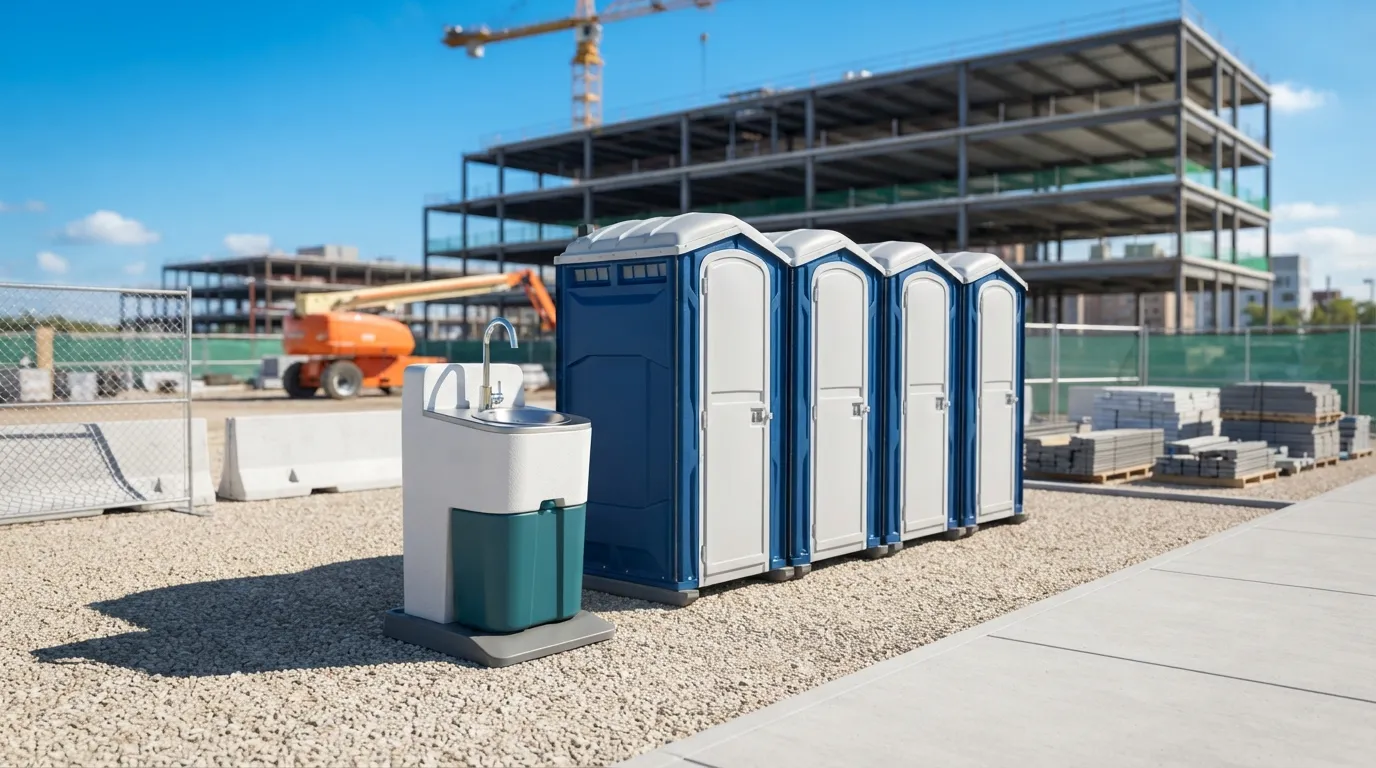
No, they cover different requirements and neither substitutes for the other. A handwashing station handles the water, soap and towel requirement under 29 CFR 1910.141(d)(2); toilet facilities are counted separately under OSHA 1926.51(c)(1). Most Pontiac sites need both side by side, and Pontiac Porta Pros typically delivers them as a pair, whether that's a standard porta potty rental or a deluxe flushable porta potty setup for a longer job. Rental costs for the toilet side vary by term:
| unit | duration | typical price |
|---|---|---|
| standard | day | $150 |
| standard | week | $200 |
| standard | month | $200 |
A standard unit holds 60 to 70 gallons and stands about 92 inches tall, footprint roughly 44 by 48 inches on the ground, which matters when you're planning tight urban lots in downtown Pontiac. For full cost breakdowns, see porta potty rental cost or porta potty rental per day. Longer builds should check monthly porta potty rental pricing before committing to weekly terms.
Do I need a permit for a handwashing station in Pontiac?
Permit rules for placement, especially anything touching the public right of way, need confirming directly with the City of Pontiac; we don't have a verified local ordinance to cite here. Check our porta potty permit requirements guide for the general process, and call the city before delivery day.
How often does a handwashing station get serviced?
ANSI/PSAI Z4.3 sets a baseline of one service visit per week for up to 10 users across a 40 hour week. Busier sites need more frequent visits. Ask about our how often are porta potties cleaned schedule when you request a quote.
What's the difference between a handwashing station and a hand sanitizer station?
A handwashing station provides running water, soap and towels, meeting 29 CFR 1910.141(d)(2). A hand sanitizer station rental does not satisfy that standard on its own. Use sanitizer stations as a supplement, not a replacement, especially near food service areas.
Does a farm site need something different than a construction site?
Yes. Farms doing hand labor fall under OSHA 1928.110, which sets a quarter-mile walking distance limit to the nearest facility. Construction crews follow 1926.51 instead. See farm and agricultural restrooms for details specific to that setup.
Can I rent just a handwashing station without a toilet?
Yes, standalone units are available for events, food trucks or smaller crews already covered elsewhere. Check handwashing station rental for standalone options, or portable sink rental if you need a sink-style unit instead of a basin.
Next step
Get a delivery date
Tell us the address, the dates and the headcount. We size the order and confirm the route.